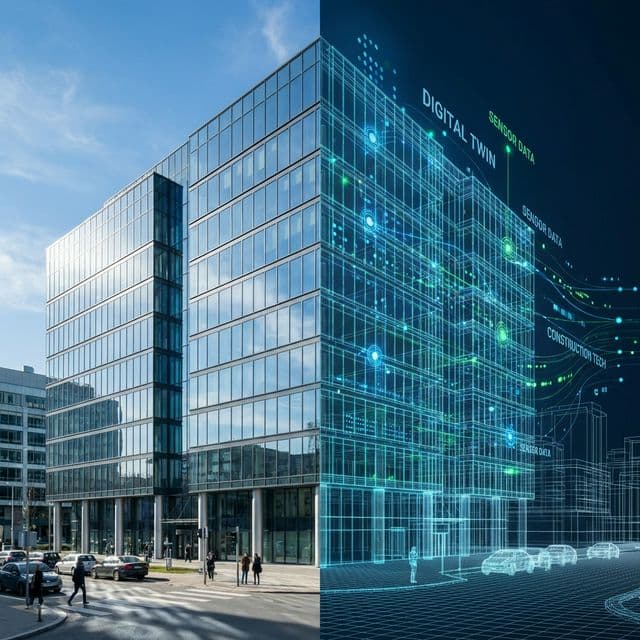
What truly is a Digital Twin?
In Real Estate, the term is often misused for simple 3D models. An authentic Digital Twin is a virtual model bidirectionally connected to the physical building via IoT sensors and real-time data. It is not a static "photo", but a living "movie" of the building.
Impact on Costs (ROI)
Recent studies show impressive figures for buildings managed via Digital Twin:
- -18% Maintenance Costs: By moving from reactive maintenance ("it broke, we fix it") to predictive maintenance ("sensor indicates abnormal pump vibrations, we intervene before failure").
- -20% Energy Consumption: Automatic HVAC optimization based on real space occupancy.
- +5-10% Lease Value: Corporate tenants seek "smart" buildings that lower their operating costs (OPEX).
Lifecycle Phases of a Digital Twin
1. Construction Phase (As-Built)
Using periodic 3D laser scanning, we compare "what was designed" (BIM) with "what is being built" (Reality Capture).
- Benefit: Detection of millimeter errors before pouring concrete or mounting facades.
2. Sales & Marketing Phase
Immersive virtual tours where the potential client can "see" how the sun will hit the office at 2:00 PM in December.
3. Facility Management Phase (75% of total costs)
This is where the real value lies. The building manager has a "visual digital manual".
- Example: A pipe burst. Instead of breaking the wall blindly, you look in the Twin, see exactly the pipe's route through the wall, and intervene surgically.
Conclusion
For developers in Romania, investing in BIM and Digital Twin is no longer a luxury option, but a major competitive differentiator. Buildings that are not "digital ready" will lose value in the coming decade.
What the process looks like on a building that already exists, step by step: 3D scanning and HBIM.