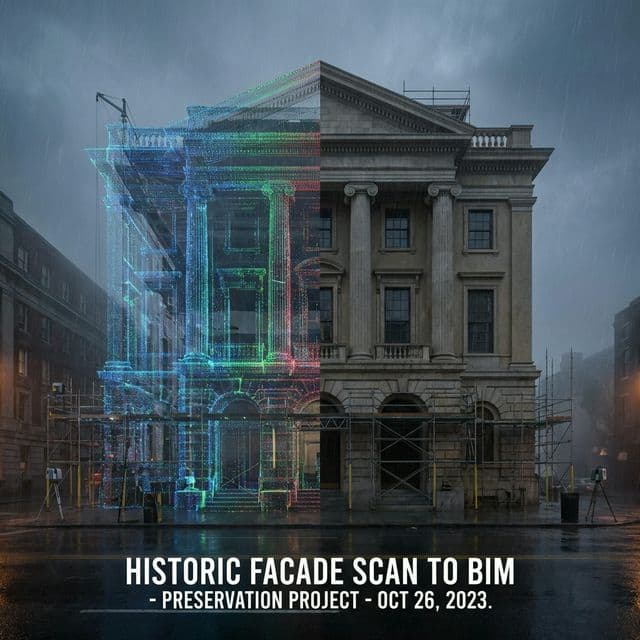
Heritage BIM (HBIM) - More than modeling
Romania has a vast architectural heritage, but many historic buildings are in an advanced state of degradation. Restoring them using classic methods (tape measure surveys) is often inaccurate due to curved walls, complex ornaments, and lack of flatness.
This is where Scan-to-BIM comes in.
The Technological Process
1. Reality Capture
We use terrestrial laser scanners (e.g., Leica RTC360) that capture up to 2 million points per second. The result is a "Point Cloud" - a perfect digital copy of the building, with sub-2mm error.
- Advantage: Non-invasive. We don't touch the building, we don't set up scaffolding for measurements.
2. Data Processing
Point clouds are cleaned of "noise" (passersby, vegetation, cars) and unified into a single coordinate system.
3. HBIM Modeling
This is the hardest part. Standard BIM software (Revit, Archicad) is designed for straight walls and 90-degree angles. Historic buildings don't have those. Our engineers model "adaptive" elements that follow the building's real deformations. We don't model an "ideal wall", but the "real wall", with all its bulges and cracks.
Levels of Detail (LOD) in Heritage
- LOD 200 (General): Building volumetrics, position of openings. Useful for preliminary energy analyses.
- LOD 300 (Specific): Main ornaments are modeled generically.
- LOD 400 (Fabrication): Each ornament is modeled exactly as it is in reality, allowing, for example, CNC milling of a stone replacement piece.
Benefits for Restoration Architects
- Infinite Sections: Once the building is scanned, you can generate sections through any point instantly.
- Degradation Analysis: Flatness maps can be generated to see exactly where the structure has settled.
- Digital Memory: Even if, God forbid, the building is destroyed (fire, earthquake), we have its perfect digital copy for reconstruction.
The model does not stop at restoration: wired to sensors it becomes a digital twin of the building. At neighbourhood scale, the same method sat under the urban regeneration study in Huși. The levels of detail and what each costs are in the service catalogue, in Romanian.